BIRDS OF PREY
Learn the stories behind these majestic raptors of the Yellowstone ecosystem.
A number of years ago, the Grizzly & Wolf Discover Center was presented with the offer to obtain two non-releasable raptors from a small zoo in western Nebraska. Since that time, the GWDC has recognized the value of taking care of numerous birds-of-prey and presenting their stories to our visitors.
All of the birds that are permitted to reside at the Grizzly & Wolf Discovery Center have been determined, by veterinarians, to be non-releasable into the wild. Some of the birds have been hit by vehicles and are unable to fly or see well, others have behavioral challenges that make it impossible for survival in the wild.
Come visit the raptor exhibits to see these amazing predators.
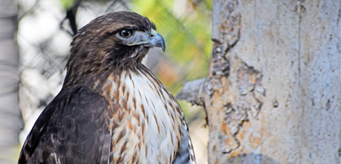
Red-tailed Hawk
LUTA
Luta is a female Red-tailed Hawk who was found in the wild with an injured leg when she was just a juvenile. During her rehabilitation she became imprinted on humans rendering her unable to survive in the wild. For Luta to become imprinted on a human means that she recognizes people as her “parents” or views all people as Red-tailed Hawks.
Red-tailed Hawks are one of the most common raptors in the United States, living everywhere from wilderness areas to Central Park in New York City.
Adopt Luta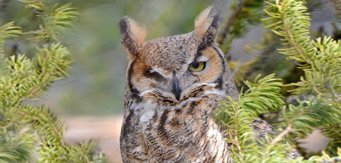
Great horned owl
CLARK
Clark is a female Great Horned Owl that arrived at the GWDC in December of 2016. She was found as a fledgling in 2015 near Billings, MT on the ground under her nest with an eye injury. After spending time at the Montana Raptor Conversation Center, it was determined that she is unable to hunt on her own and therefore can never be released back into the wild.
Adopt Clark
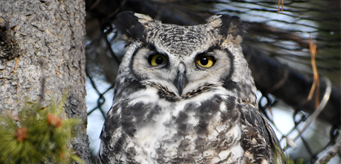
Great horned owl
STRETCH
Stretch is a male Great Horned Owl that arrived at the GWDC in December of 2016. He and his siblings were found on the ground under their nest near Billings, MT in 2014. After spending time at the Montana Raptor Conversation Center, it was determined that he cannot survive in the wild because he is unable to hunt on his own due to a birth defect in one of his eyes. Great Horned Owls can be easily identified by their horn-like tufts and white patch of feathers on the chest. Their brown, black, white and gray streaked body feathers help them blend well with their surroundings.
Adopt Stretch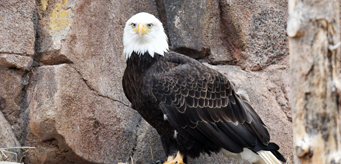
Bald Eagle
ZACK
Bald eagle Zack has a similar story to Josh. He was found in the wild and brought to the Dakota Zoo with a severely dislocated wing. His wing was set back in place but has never been strong enough for him to fly. Although, the details of how Zack’s injury occurred are unclear, the majority of accidents and mortality of eagles is caused by humans. In some areas, large birds of prey like eagles, obtain their food by scavenging along roadsides which causes some to be injured by passing vehicles.
Adopt Zack
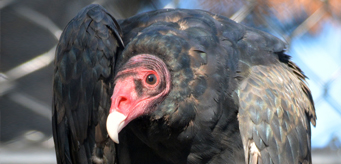
Turkey vulture
LEWIS
When Lewis was a nestling he was brought to a rehabilitation center in Utah with fractures to some of his left wing bones. These bones had begun to heal out of place. As a result, Lewis’s wing does not work correctly and he cannot fly. Turkey vultures can easily be recognized in flight by the way they hold their wings. Their wings are held in an upward-pointing “V” shape, also known as a dihedral.
Adopt Lewis
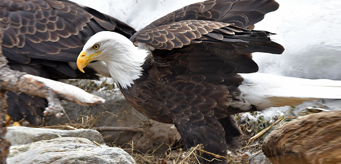
Bald Eagle
JOSH
Josh, a male bald eagle, was brought to the Dakota Zoo in Bismarck, North Dakota in 2006. Josh was shot in the left wing resulting in badly fractured bones and the presence of lead particles in his wing. Unfortunately, the wing needed to be amputated at the wrist. He was named after an Army Veteran who served in Iraq. Josh and the other birds-of-prey at the Center are used for outreach programs and educational programs in an effort to generate better understanding and deeper appreciation of the species.
Adopt Josh


